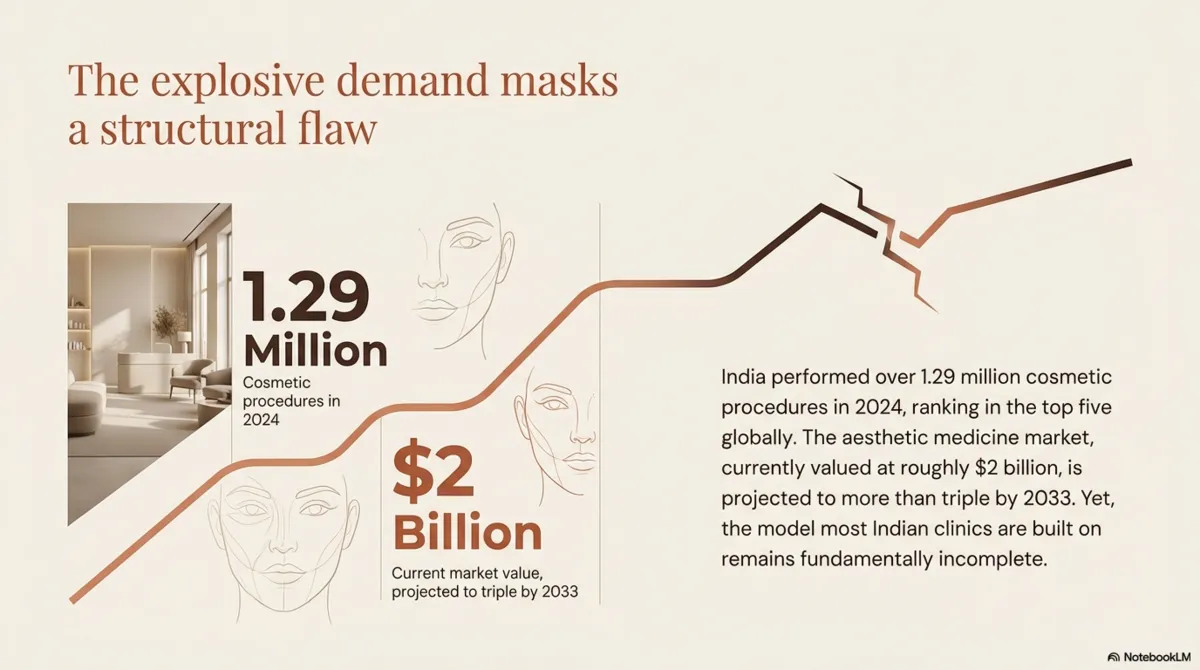
India did 1.29 million cosmetic procedures last year. The market's worth $2 billion and climbing fast — projected to triple by 2033. We're in the top five globally for total procedures. Rhinoplasty volumes here trail only a handful of countries worldwide.
Impressive numbers. But they hide a problem almost nobody in the industry wants to discuss: the model most Indian aesthetic clinics are built on is broken at the foundation. The answer isn't more treatments — it's a fundamentally different approach called integrative aesthetics, and it's only just arrived in urban India.
Why Standard Derma Clinics Have a Ceiling
Walk into any aesthetic clinic in Gurgaon, Delhi, Mumbai, or Bangalore — and you already know what's on the menu. Laser hair removal. Chemical peels. Anti-wrinkle injections. Fillers. PRP for hair loss. Maybe some body contouring. The treatments are skin-deep, literally. For a lot of patients, that's fine.
But not for everyone.
Urban professionals in their thirties and forties are showing up at these clinics carrying a complicated mix of problems — skin issues, yes, but also chronic fatigue, hormonal imbalances, stress-related weight gain, poor gut health, accelerated ageing. And the derma clinic, however well-equipped, has nothing left to offer them. It treats what's visible on the surface. The root cause — operating quietly inside the body — stays untouched.
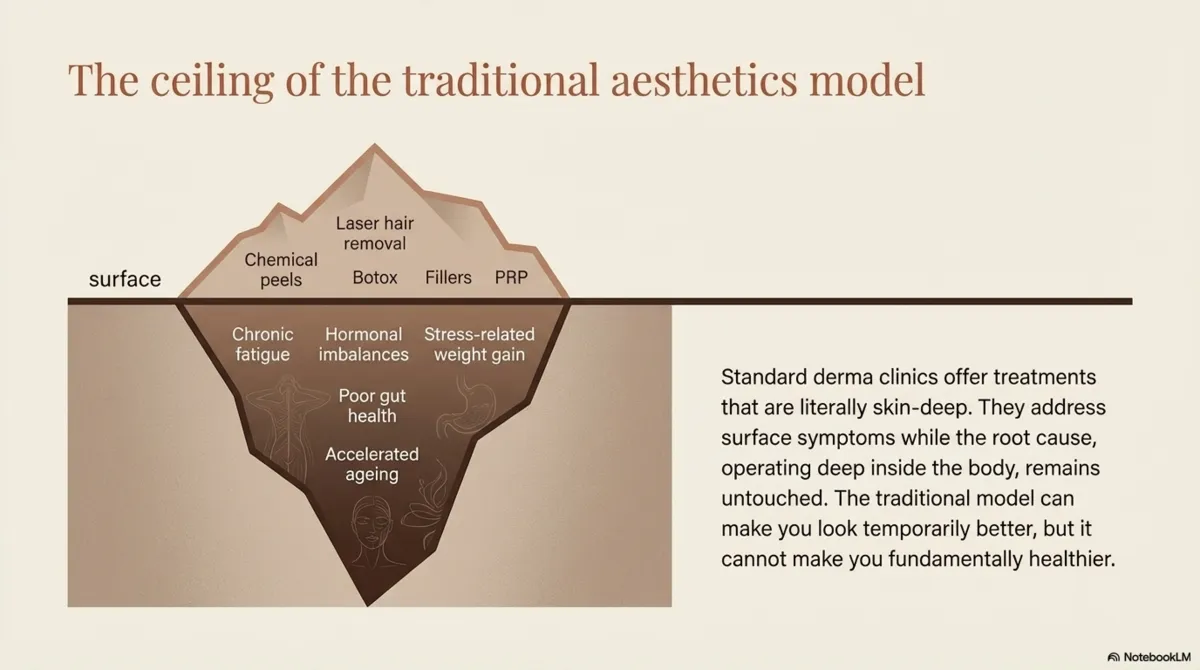
That's the ceiling. The traditional aesthetics model can make you look temporarily better. It can't make you fundamentally healthier. More and more informed consumers are starting to realise these two things aren't actually separable.
What the World's Leading Integrative Clinics Already Know
The notion that skin care and health care belong in separate buildings — one clinic for your skin, another for your hormones, a third for your gut — reflects how the Indian healthcare system is organised. It doesn't reflect how the human body works.
The world's leading wellness institutions understood this years ago. SHA Wellness Clinic in Spain, a World Spa Award winner, weaves Western diagnostic medicine together with natural therapies, clinical nutrition, and regenerative protocols. Clinique La Prairie in Switzerland — founded in 1931 — fields over fifty medical specialists working across brain health, cellular ageing, and precision medicine, all within one programme. Lanserhof in Germany built its entire clinical philosophy on a single premise: gut health, metabolic function, and physical appearance are interconnected systems that need to be treated together.
These places don't command fierce patient loyalty because they offer more treatments. They earn it because they treat the whole person. A patient arriving at SHA for skin rejuvenation doesn't leave with just a laser session. They get a full health assessment, a personalised nutrition protocol, IV nutrient therapy targeting cellular deficiencies, and a follow-up plan built around what's actually driving their skin concerns from the inside.
That's integrative aesthetics. And until very recently, nothing like it existed in urban India.
The Gap in India's Aesthetic Medicine Market
India has world-class dermatologists. Excellent plastic surgeons. A small but growing cohort of functional medicine practitioners. And luxury destination retreats — Atmantan, Six Senses Vana — that offer genuinely integrative health experiences. But only as multi-day residential programmes. You need to travel, take a week off work, and spend accordingly.
What's been absent is the urban integrative clinic. A place in Gurgaon where a working professional can walk in and access clinical-grade aesthetic treatments and functional medicine and advanced modalities — ozone therapy, IV nutrition, red light therapy, gut health protocols — all coordinated by a single medical team, without flying to Switzerland or driving to a hill station.

That's the gap House of Aetheria was built to fill.
What Integrative Aesthetics Actually Looks Like in Practice
"Integrative" gets thrown around loosely in Indian wellness marketing. So here's what it means in practice.
A patient walks in with persistent adult acne, low energy, and patchy hair thinning. Three concerns. At a traditional clinic, that's three separate specialists — a dermatologist prescribing topicals, an endocrinologist running hormone panels, a trichologist recommending PRP. Three treatment plans. Three sets of bills. Zero coordination.
In an integrative model, those three symptoms are read as potentially connected — perhaps gut dysbiosis fuelling the inflammation showing up as acne, poor nutrient absorption causing the hair thinning, hormonal imbalance behind the fatigue. Before anyone picks up a laser, there's a root-cause assessment: detailed bloods, gut health evaluation, hormonal profiling, full medical and lifestyle history.

The plan that follows might combine targeted IV nutrition to correct deficiencies fast, ozone therapy to address gut dysbiosis and reduce systemic inflammation, an anti-inflammatory nutrition protocol, and — alongside all of it — the right aesthetic interventions, timed to work with the internal healing rather than against a body that isn't ready to support them.
Not theoretical. This is what clinical care looks like when aesthetics and functional medicine stop competing and start operating as one system.
The Science Behind Skin, Gut Health & Hormonal Balance
The link between internal health and external appearance isn't speculative. It's documented.

The gut-skin axis is one of the most researched connections in integrative medicine. Disruptions in gut microbiome diversity are directly linked to inflammatory skin conditions — acne, rosacea, eczema, psoriasis. Patients with compromised gut health show up with dull, reactive skin that doesn't respond to topical treatments. Because the problem isn't on the skin. It's in the intestine.
The hormone-skin-hair connection is just as well-established. Thyroid dysfunction, insulin resistance, cortisol dysregulation, oestrogen-progesterone imbalances — they all have visible consequences. Hair loss rates. Skin quality. Body fat distribution. Rate of visible ageing. A filler can soften a hollowed cheek caused by cortisol-driven collagen breakdown. It can't fix the cortisol problem that's causing it.
Chronic inflammation — from poor nutrition, environmental toxins, stress, disrupted sleep, metabolic dysfunction — degrades collagen and elastin, slows cellular turnover, impairs wound healing. It creates the "tired" look that injectable treatments can't touch. Reduce the systemic inflammation, and two things happen: patients feel better and their skin responds measurably better to aesthetic treatments.
Patients who undergo functional health optimisation before and alongside aesthetic procedures consistently achieve better, longer-lasting cosmetic outcomes. The treatment works harder when the body supporting it is actually functioning.
Ozone Therapy, IV Nutrition & the Advanced Treatments Driving This Shift
A key reason this model has become viable is the maturation of several therapeutic modalities that bridge clinical medicine and wellness.
- Ozone Therapy (MAH) A small volume of the patient's blood is drawn, enriched with medical-grade ozone, and reintroduced intravenously. Used in European integrative medicine for decades. Applications include immune modulation, systemic inflammation reduction, and gut healing support — a pathway that topical dermatology simply can't provide.
- IV Nutrient Therapy Vitamins, minerals, amino acids, and antioxidants delivered directly into the bloodstream — bypassing a digestive system that may already be failing to absorb them. Particularly valuable before or after aesthetic procedures. The Myers' cocktail (magnesium, calcium, B vitamins, vitamin C) is one of the most widely used protocols internationally.
- Red Light Therapy Specific wavelengths of light (photobiomodulation) stimulate cellular energy production, promote collagen synthesis, reduce inflammation, and accelerate tissue repair. One of the few modalities with a growing evidence base for both aesthetic enhancement and functional health — from post-surgical recovery to standalone skin rejuvenation.
- Molecular Hydrogen & Hyperbaric Oxygen Newer additions to the integrative toolkit, with applications in oxidative stress reduction, energy restoration, and cellular recovery. The research is still developing — but the early results are compelling.
No single therapy here is the point. The point is the ability to combine them into coordinated protocols addressing a patient's health from multiple angles at once. That's what separates an integrative clinic from a standard aesthetics practice that happens to offer one or two "wellness add-ons."
Why Gurgaon Is the Right City for Integrative Aesthetics
This isn't accidental timing.
Gurgaon's population skews younger, more affluent, and more globally mobile than most Indian cities. A significant chunk of residents have lived or worked abroad — the US, Europe, Southeast Asia. They've encountered integrative health models firsthand. They know what's possible. They're looking for it here.
The corporate wellness crisis is visible on the street. Gurgaon runs on long hours, sedentary desk work, high stress, bad eating, and disrupted sleep. The aesthetic fallout — premature ageing, stress-driven skin conditions, hormonal chaos, weight gain — is exactly what integrative medicine is designed to address. A standard derma clinic can treat the dark circles. It can't treat the burnout that caused them.
And consumer sophistication is outpacing the clinics. Forty percent of aesthetic patients are now aged 20 to 30. They research before they book. They follow international wellness practitioners and clinics. They read about functional medicine, gut health, longevity protocols. They're not interested in a clinic that only treats the surface. They want to understand why their skin looks the way it does — not just what treatment someone wants to sell them.
How to Choose an Integrative Aesthetics Clinic in India
If you're navigating the aesthetics landscape in India right now, ask different questions.
Not just "what treatment do you recommend?" but "is there an internal driver behind this?" Not just "how many sessions?" but "is my body actually in a state to respond to this treatment?"
The patient who's tried three laser clinics for persistent pigmentation without lasting results may not need a better laser. They may need someone who investigates whether oestrogen dominance, liver congestion, or chronic inflammation is driving the melanin overproduction.
Look for clinics that take a medical history before they recommend a treatment menu. That offer diagnostics — bloods, gut health assessment, hormonal profiling — alongside their aesthetic services. That have practitioners who can connect what's happening inside your body to what's showing up on your face.
The most valuable aesthetic investment isn't always the one with the most dramatic before-and-after. Sometimes it's the one that fixes the foundation — the internal health — that every external treatment rests on.
House of Aetheria is an integrative wellness and aesthetics centre in Gurugram, combining clinical-grade aesthetic treatments and plastic surgery led by Dr. Rahul Jain (MCh, Fortis Manesar) with functional medicine, ozone therapy, IV nutrition, red light therapy, and personalised wellness programmes — India's first urban integrative clinic built to treat the whole patient, inside and out.