


Hair Transplant in Gurgaon
Natural hairline. Permanent results.
WhatsApp UsBefore & After Hair Transplant
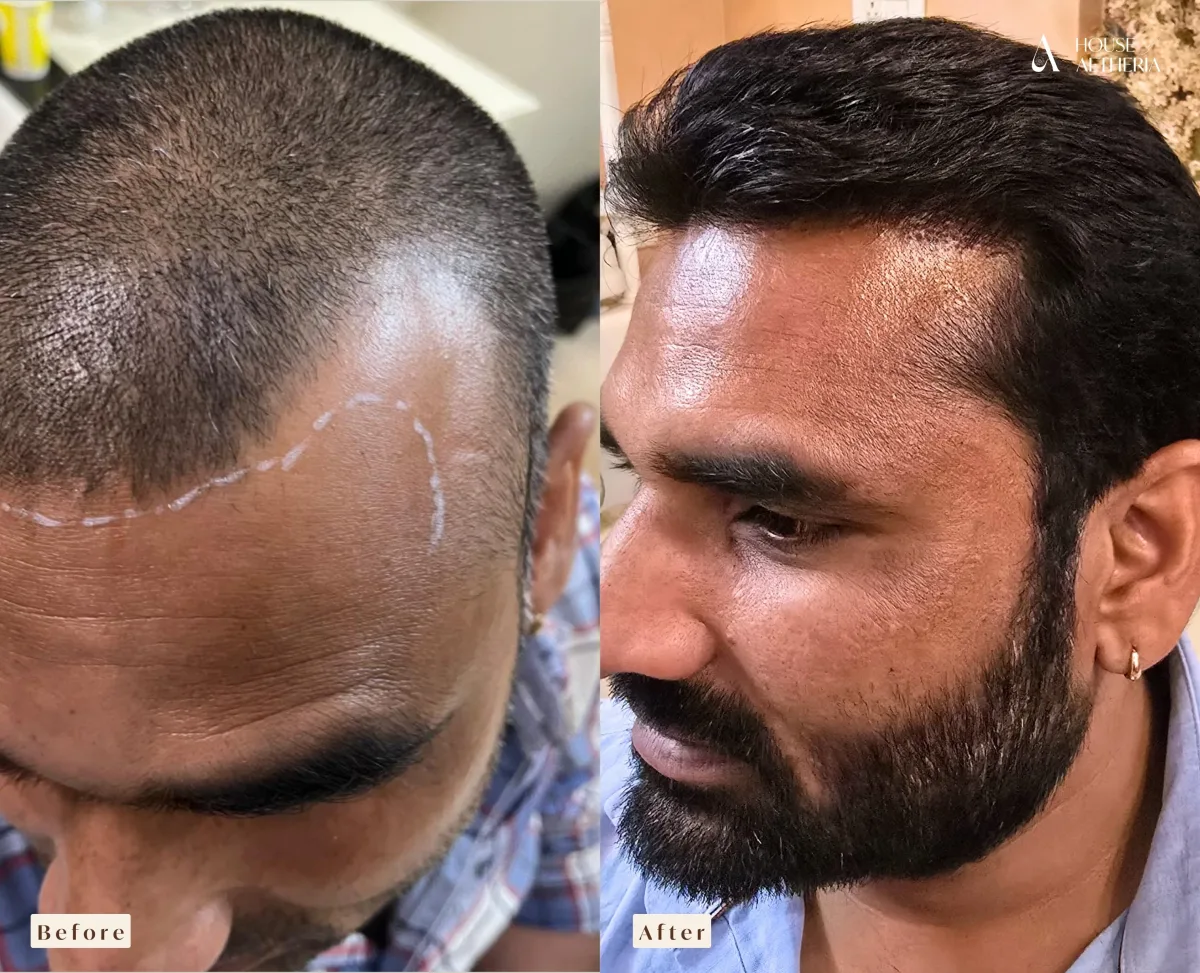
Individual results may vary. Photos show actual patients treated at House of Aetheria. Displayed with patient consent.
Are You a Candidate for Hair Transplant?
Understanding Hair Loss and How Transplant Works
For most people, hair loss is not a single event — it is a slow, progressive process that begins years before it becomes visible. Understanding what is actually happening beneath the scalp is the first step toward a decision that lasts.
The most common cause of hair loss in both men and women is androgenetic alopecia — a genetically predetermined sensitivity to dihydrotestosterone (DHT). DHT binds to hair follicle receptors and triggers a process called miniaturisation: follicles progressively shrink, produce finer and shorter hairs, and eventually stop producing hair altogether. In men, this follows the Norwood scale — starting with a receding hairline or crown thinning and advancing predictably over years. In women, the Ludwig scale maps a diffuse thinning pattern that tends to spare the frontal hairline. The critical point is this: once a follicle miniaturises completely, no topical product or supplement will revive it. The loss is structural, not nutritional.
A hair transplant works by relocating follicles from your permanent donor zone — the back and sides of the scalp, where hairs are genetically resistant to DHT — to the areas where miniaturisation has occurred. These transplanted follicles carry their DHT-resistance with them. They grow, they shed in the normal cycle, and they regrow — for life. At House of Aetheria, Dr. Rahul Jain performs FUE (Follicular Unit Extraction): individual follicular units are harvested one by one using a precision micro-punch (0.6–0.9 mm), leaving no linear scar and allowing a return to normal activity within days. Each graft is then implanted at an angle, depth, and density calibrated to the natural growth pattern of that specific scalp zone.
Hairline design is as much art as science. An overly low or perfectly straight hairline looks unnatural at 45. Dr. Rahul Jain designs every hairline to be appropriate for your age, facial proportions, and likely progression over the next two decades — ensuring the result looks natural not just at 12 months, but at year ten. Learn more about Dr. Jain's approach →
FUE is not the only technique available. FUT (Follicular Unit Transplant) harvests a strip of scalp from the donor area — yielding a higher graft count in a single session but leaving a linear scar at the back of the head. DHI (Direct Hair Implantation) uses a specialised implanter pen that allows simultaneous extraction and implantation, reducing graft handling time and suiting patients with shorter desired hair lengths. Dr. Rahul Jain is trained in all three and recommends the technique based on your anatomy, graft requirement, and lifestyle — not because one method is categorically superior.
The FUE Surgical Approach at House of Aetheria
Performed by Dr. Rahul Jain, MCh (Plastic Surgery)The procedure begins with a detailed pre-operative mapping session. Dr. Rahul Jain marks the donor zone, counts available follicular units using a digital trichoscope, and finalises the hairline design in consultation with the patient. No extraction begins until the design is confirmed and agreed upon.
Local anaesthesia is administered to both the donor and recipient areas. The extraction phase uses a motorised micro-punch (0.6–0.9 mm) to loosen and remove individual follicular units — each containing 1 to 4 hairs — from the permanent donor zone. Grafts are immediately placed in a chilled holding solution to preserve viability. The extraction pattern is randomised across the donor area to prevent visible thinning.
In the implantation phase, recipient sites are created using custom-gauge needles at angles and depths precisely calibrated to match the natural hair growth direction of each scalp zone. Grafts are then placed individually — frontal hairline single-hair grafts at the edge, multi-hair grafts behind for density. The result is a graduated, natural-looking density that photographs and behaves exactly like native hair.
The entire session takes 6–8 hours for 2,500–4,000 grafts. Patients remain awake and comfortable throughout, with meals and refreshments provided. The clinic uses sterile, single-use instruments for every procedure — no recycled punches.

What FUE Can and Cannot Do
Results We Can Achieve
- Restore a natural hairline for Norwood grades 2–5Adequate donor density required — assessed at consultation
- Fill crown thinning and midscalp density loss
- Beard, moustache, and eyebrow restoration using scalp donor grafts
- Coverage of surgical scars, burn scars, or trauma-related hair loss
- Correction of previous hair transplant — unnatural hairline, pluggy appearance, or low density
- Restore hairlines in women with stable female-pattern loss (Ludwig 1–2)
- Permanent results — transplanted hairs are DHT-resistant and grow for life
Situations That Need a Different Approach
- Active alopecia areata or diffuse unpatterned alopeciaSurgery risks spreading active immune-mediated loss — medical stabilisation first
- Insufficient donor density (< 40 FU/cm²)Not enough viable grafts to cover the area of loss
- Active hair loss without medical stabilisationTransplant into progressive loss produces inconsistent results
- Norwood 6–7 with severely depleted donor zoneMay require multiple sessions or combined therapy — discussed honestly at consultation
- Expecting 100% restoration of original densityTransplant redistributes your existing hair — it does not create new follicles
- Scalp skin infections or active inflammatory conditions in treatment area
- Patients within 12–18 months of completing chemotherapy or radiation
Hair Transplant: What to Expect
Every hair transplant at House of Aetheria begins with a thorough scalp and donor zone assessment. Dr. Rahul Jain evaluates your hair loss pattern, donor density, scalp laxity, and long-term goals before recommending a graft count and hairline design. No two cases are identical — and no surgery date is confirmed until we are certain the plan is right for your anatomy.
The full process from consultation to visible results spans approximately 12–18 months. Below is what each stage involves.
- Consultation with Dr. Rahul Jain: scalp assessment, hair count analysis, donor zone evaluation, hairline design discussion
- Medical clearance and blood work required before a surgery date is confirmed
- Stop blood thinners, aspirin, and alcohol 7 days before surgery
- Wash hair thoroughly on the morning of the procedure; do not apply styling products
- Wear a comfortable, loose-fitting button-down shirt on the day
- Arrange for someone to drive you home after the procedure
- Local anaesthesia administered to both donor and recipient zones — you feel no pain
- Extraction phase: 3–4 hours; individual follicles harvested using 0.6–0.9mm micro-punch
- Grafts stored in a specialised holding solution to preserve viability
- Implantation phase: recipient sites created at precise angles matching natural hair direction
- Total session: 6–8 hours; meals provided for full-day procedures
- You remain awake and comfortable throughout — rest, music, or films during the session
- Keep grafts completely dry for the first 72 hours
- Gentle washing with prescribed solution from day 4 onwards
- Return to desk work within 3–5 days; avoid strenuous exercise for 10 days
- Transplanted hairs shed at weeks 2–4 — this is normal; follicles remain intact beneath the scalp
- New hair growth begins from month 3; significant density visible at 6–9 months
- Full results at 12–18 months; follow-up appointments at 10 days, 1 month, 3 months, and 12 months
What Our Patients Say
Dr. Rahul is highly knowledgeable in his field, and meeting him gave me complete confidence. I received the most genuine treatment, perfectly aligned with my purpose of visiting. My trust was truly earned through the results, and I would definitely choose House of Aetheria again.
I had a complex procedure with Dr. Rahul Jain. I had consulted several surgeons before choosing him. He took the time to understand both my functional and aesthetic goals together, and the outcome has genuinely changed how I feel about myself.
I travelled from abroad specifically for my procedure with Dr. Rahul Jain, and it was worth every bit of planning. From the first consultation, he was thorough, honest about expectations, and made me feel completely at ease. The aftercare and follow-up were excellent even after I returned home.
Individual results may vary. Testimonials are from patients treated at House of Aetheria.
Frequently Asked Questions
What is the cost of hair transplant in Gurgaon?
How long does hair transplant surgery take?
When will I see hair transplant results?
Is hair transplant permanent?
What is the recovery time after FUE hair transplant?
What Norwood grade is suitable for hair transplant?
Can I get a beard or eyebrow transplant?
Can PRP be combined with hair transplant?
Speak with Dr. Rahul Jain
A brief conversation with Dr. Rahul Jain clarifies your graft requirement, hairline design, and expected outcome — whether you are ready for surgery, would benefit from non-surgical treatment first, or simply need more time to decide. No commitment required.
+91-92899 93791We've received your request
Our team will call you within 2 hours to confirm your consultation with Dr. Rahul Jain. If you'd like to connect sooner:
WhatsApp us now