

House of Aetheria · Surgery
Rhinoplasty in Gurgaon
Rhinoplasty reshapes the nose to bring it into balance with your face, and can also improve breathing. Plastic surgeon Dr. Rahul Jain plans every nose for its own anatomy, including the thicker skin, broader base and softer cartilage common in Indian noses, so the result looks natural and suits you.

You've been researching rhinoplasty for a long time, and you haven't told many people.
It is not that you're being careful. It is that no one has told you what the first consultation actually involves, so every article adds a new unknown.
The first visit is a conversation about what you want and what is realistic. There is no pressure to book, and you're welcome to bring your questions in writing.
In short
Rhinoplasty at House of Aetheria, Sector 65, Gurugram, is performed by plastic surgeon Dr. Rahul Jain, who plans each nose for Indian facial anatomy. Options include open and closed rhinoplasty, septorhinoplasty for breathing, tip plasty, alarplasty, wide nose correction, revision surgery, and non-surgical liquid rhinoplasty. Surgery is done under general anaesthesia as a day case, most people return to desk work in 10 to 14 days, and the final shape settles over about a year.
Is it for you?
Who rhinoplasty suits
- A bump or hump on the bridge of the nose
- A wide, bulbous or drooping nose tip
- Wide nostrils or a broad nose base
- A crooked or asymmetric nose
- Trouble breathing through the nose, for example from a deviated septum
- An earlier nose surgery you are not happy with
- Wanting a nose that balances the rest of your face
Choose your procedure
Types of rhinoplasty we offer
Every nose is different, so the technique is chosen after your examination. Each option below has its own guide with more detail.
Open and closed rhinoplasty
- Open: a small cut across the strip between the nostrils gives full access for bigger changes
- Closed: all cuts are inside the nostrils, with no outside scar, for more limited changes
- Read open vs closed rhinoplasty
Septorhinoplasty
- Corrects a deviated septum and reshapes the nose in one operation
- Helps if the nose is blocked as well as unhappy in shape
- Read septorhinoplasty and rhinoplasty and breathing
Tip plasty
- Reshapes a bulbous, wide or drooping tip without changing the bridge
- Often a smaller operation than full rhinoplasty
- Read tip plasty and drooping nose tip after 30
Alarplasty and wide nose surgery
- Narrows wide nostrils through a scar hidden in the natural crease
- Wide noses can need the nose base and tip refined together
- Read alarplasty and wide nose surgery
Revision rhinoplasty
- For a nose that healed badly, or surgery done elsewhere, including abroad
- A more complex operation that needs careful planning
- Read revision rhinoplasty and correcting bad results abroad
Liquid rhinoplasty (non-surgical)
- Filler is used to smooth a small bump or lift a tip, with no surgery
- Lasts for months, not permanently, and cannot make a nose smaller
- Read liquid vs surgical rhinoplasty
For men and for women
- Men often want a stronger, straight profile without a scooped look
- Women often want a refined tip, kept natural and in balance
- Read rhinoplasty for men and rhinoplasty for women
Why it matters
Planning for Indian noses
Indian noses often differ from the noses that most surgical textbooks are based on. A good plan allows for this.
- Thicker skin, which shows less definition and swells for longer
- A broader base and wider nostrils
- Softer, weaker cartilage, which needs support
- Skin that can darken if it is handled or healed poorly
- Your own features, which should stay recognisably yours
At a glance
The operation in short
- Surgery is usually done as a day case
- General anaesthesia
- About 2 to 4 hours, depending on the work needed
- Desk work in about 10 to 14 days
- Swelling settles slowly: most of it in a few months, full shape at about a year
Your journey
From consultation to healing
Consultation
Dr. Rahul Jain examines your nose inside and out, looks at your face as a whole and asks what you want to change.
Planning
You agree the technique and what is realistic. Photos and a health check come before a date is set.
Surgery day
Surgery is done under general anaesthesia as a day case. You go home with a splint and clear instructions.
Healing
The splint comes off after about a week. Swelling and bruising fade over the following weeks, and you come back for reviews.
Recovery
What recovery looks like
- First week: a splint on the nose, some swelling and bruising, and rest at home
- Weeks 1 to 2: most people are back at desk work, with the splint off
- Weeks 2 to 6: bruising gone, swelling fading, and no sport or heavy lifting
- Months 3 to 6: much of the swelling has settled, and the shape keeps refining
- Around 12 months: the tip and skin finish settling into the final shape
Read our week-by-week guide to rhinoplasty recovery, and the swelling timeline.
Straight talk
What rhinoplasty can and cannot do
- It can reduce a bump, refine the tip, narrow the base and straighten the nose
- It can improve breathing when a septum or other blockage is the problem
- It cannot show the final result straight away. Swelling takes months to settle
- It cannot give you someone else's nose. A good result respects your own features
- Fillers can change the shape a little, but they cannot make the nose smaller
Real patients
Results you can see


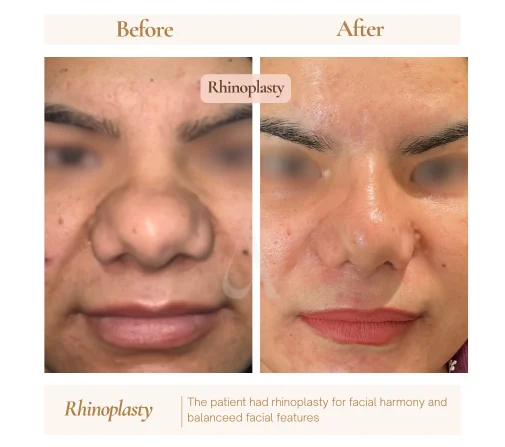
Patient photos, shared with consent. Results vary.
See more on our rhinoplasty before and after gallery.
Choosing a surgeon
Questions to ask before you choose
- Is the surgeon a qualified plastic surgeon, and will they operate on you themselves?
- How many noses like mine have they operated on, and can they show real before and after photos?
- Will they explain the risks and what they cannot do, and not only the best case?
- Will they be available for follow-up if something needs attention?
- Do they plan for Indian nasal anatomy and skin?
Read more in how to choose a safe rhinoplasty surgeon.
Helpful guides
Read before you book
How to choose a safe rhinoplasty surgeon
What to check, and what ten years after surgery can teach you.
Read the guide →What affects the cost of rhinoplasty
Why quotes differ and what you are paying for.
Read the guide →Rhinoplasty recovery, week by week
A realistic timeline for Indian patients.
Read the guide →Rhinoplasty swelling timeline
How the nose looks at each stage.
Read the guide →Liquid vs surgical rhinoplasty
When filler is enough and when surgery is better.
Read the guide →Rhinoplasty in Gurgaon: the full guide
Why Indian noses need specialist planning.
Read the guide →Your Doctor

Dr. Rahul Jain
Consultant Plastic & Reconstructive Surgeon · MBBS, MS, MCh (Plastic Surgery)
All rhinoplasty at House of Aetheria is performed by Dr. Rahul Jain at our Sector 65 clinic in Gurugram. Your consultation is with him, so you meet your surgeon before you decide anything.
View full profileFrequently Asked Questions
Straight answers about rhinoplasty, from our Sector 65 clinic in Gurugram.
The cost depends on the technique, how complex the work is, and whether it is a first surgery or a revision. Dr. Rahul Jain gives you a clear plan and cost at your consultation, after he has examined your nose.
Open rhinoplasty uses a small cut across the strip between the nostrils for full access. Closed rhinoplasty keeps all cuts inside the nostrils. Your surgeon picks the one that suits the changes you need.
Most people return to desk work in about 10 to 14 days, with the splint off after about a week. Swelling fades over months, and the final shape shows at around a year.
You are under general anaesthesia, so you feel nothing during surgery. Afterwards most people describe pressure and a blocked, congested nose more than sharp pain, and simple pain relief from your surgeon handles it. The splint comes off after about a week.
With closed rhinoplasty there are no outside scars. With open rhinoplasty the small scar on the strip between the nostrils fades well for most people.
It uses filler to smooth a small bump or lift the tip without surgery. It lasts for months, not permanently, and it cannot make the nose smaller.
It corrects a deviated septum and reshapes the nose in one operation. It helps when the nose is blocked as well as unhappy in shape.
The reshaping is permanent, though the nose keeps ageing like the rest of your face. Fillers are not permanent.
Yes. Men have it for the same reasons, and the plan keeps a strong, natural profile.
Often, yes. Revision rhinoplasty is more complex, and needs careful planning. Your surgeon will tell you what is realistic.
You see much of the change within weeks, but swelling takes months to settle. The final shape, especially of the tip, shows at around a year.
Explore More
Related procedures
You've done the research. The next step is one private conversation.
Sector 65, Golf Course Extension Road, Gurugram
Open 10:00 am to 07:30 pm