The best hair transplant in Gurgaon is not the one with the lowest price per graft, the most Instagram testimonials, or the most technician-heavy operating theatre. It is the one performed by a qualified surgeon who tells you what you actually need — and is honest when you don't need surgery at all.
Hair transplantation has changed. The science is genuinely good. The outcomes, when the right candidate undergoes the right technique with an experienced surgeon, are reliable and natural-looking. What has not changed is the number of patients who arrive at clinics having been given incomplete or misleading information — about technique differences, graft counts, recovery, and what "results" realistically means for their hair type and pattern of loss.
This article is written to correct that. Consider it the consultation you should have before your consultation.
Who Actually Needs a Hair Transplant
Not everyone with thinning hair is a transplant candidate. This sounds obvious — but it is the question many clinics skip.
Hair transplantation is a surgical redistribution of existing hair from a donor zone (typically the back and sides of the scalp, which are genetically resistant to DHT-driven loss) to areas that have thinned or lost hair permanently. The critical word is permanently. Transplantation treats established, stable loss — not active, progressing loss or loss caused by reversible factors like nutritional deficiency, hormonal imbalance, or prolonged stress.
Patients at Norwood grades 3 through 5 on the Hamilton-Norwood scale are generally the best candidates. Grade 3 shows deepened temporal recession. Grade 4 adds significant crown loss. Grade 5 shows a narrowing bridge of hair between the two areas. Grades 6 and 7 involve extensive loss — transplants are possible but require realistic expectations about achievable density and may require staged procedures.
Before recommending surgery, a thorough consultation at House of Aetheria will assess whether your loss is stable, whether non-surgical options like PRP, exosomes, or mesotherapy could address your current stage more appropriately, and whether the donor zone has sufficient density to support the coverage you want.
How Many Grafts Do You Actually Need
Graft count is the number clinics most frequently inflate in sales-oriented consultations — and the one patients most frequently misunderstand. More grafts does not mean better results. Appropriate grafts for your area, placed at the right density and in the right groupings, does.
Indian hair has a natural advantage here. Its higher calibre (thickness per strand) and slight wave create better visual coverage per graft than fine, straight Caucasian hair. A well-placed 2,500-graft session on Indian hair can achieve the coverage that might require 3,500 grafts on finer hair.
These are indicative ranges. Actual graft requirements depend on scalp laxity, donor density, recipient area size, and the density target you and your surgeon agree on. Scalp mapping during consultation gives precise numbers.
FUE vs DHI vs FUT — The Honest Comparison
Three techniques dominate the conversation. Here is what each actually means — stripped of marketing language.
| Technique | Scarring | Graft Survival | Recovery | Best For |
|---|---|---|---|---|
| FUE Follicular Unit Extraction |
Tiny circular punch scars across donor zone; invisible with hair ≥1cm | 90–95% when grafts kept moist and implanted promptly | 7–14 days to return to normal activity; no stitches | Most patients; large graft sessions; those wanting short haircuts |
| DHI Direct Hair Implantation |
Same punch scars as FUE; no recipient incisions visible | 90–97%; reduced ischemia time via Choi pen may improve viability marginally | Comparable to FUE; slightly less scalp trauma at recipient site | Hairline precision; transplanting into existing hair without shaving; lower graft sessions |
| FUT Follicular Unit Transplantation / Strip |
Linear scar at donor site; concealed with hair of normal length | 90–95%; established technique with long-term data | 10–14 days; stitches removed at day 10–12 | Patients needing large graft counts in one session; those unconcerned about linear scar |
Graft survival figures are technique benchmarks under optimal conditions. Actual outcomes depend on surgeon skill, graft handling, storage solution, and post-operative care.
The honest conclusion: FUE and DHI are both refinements of the same core principle. When performed by an experienced surgeon with careful graft handling, their outcomes are clinically comparable. The choice between them should be driven by your specific hair loss pattern, whether recipient-area shaving is acceptable, and what graft count your session requires — not by which technique carries a premium price tag.
FUT is less commonly offered today but remains a valid option for patients who need maximum graft yield from a single session and whose donor area is better suited to strip harvesting. The linear scar is a real trade-off — honest clinics acknowledge it plainly.
"The technique matters far less than the surgeon's judgment. I have seen beautiful FUE results and terrible DHI results from the same marketing pitch. The questions to ask are not about technique names — they are about who is doing the work and what their track record looks like with patients who have hair like yours." — Dr. Rahul Jain, MCh Plastic Surgery, House of Aetheria
What the Procedure Involves at House of Aetheria
A hair transplant at House of Aetheria begins well before the operating day. Your consultation includes a detailed trichoscopy assessment to evaluate follicular health across the donor and recipient zones, a scalp laxity check, and blood work to rule out any active systemic factors that could compromise healing or graft survival. Patients on certain medications — including finasteride, minoxidil, blood thinners, and some supplements — are assessed individually for protocol adjustments.
On the day of the procedure:
- Local anaesthetic is administered to the scalp — this is the most uncomfortable part of the day, lasting a few minutes
- Grafts are extracted individually using precision micro-punch tools (0.7–0.9mm), preserving surrounding follicles
- Extracted grafts are kept in a specialised holding solution to maintain viability — graft survival rates fall measurably when grafts are left exposed without adequate preservation
- Recipient sites are created at natural angles and directions matching your existing hair pattern
- Grafts are implanted — singles placed at the hairline for a soft, natural border; doubles and triples placed behind for density
Sessions typically run six to ten hours depending on graft count. Patients are awake throughout. Most describe the experience as tedious rather than painful.
Post-procedure, you leave with a written care protocol, a prescribed medication schedule, and a direct line to the clinic for any questions during recovery.
The Recovery Timeline — Month by Month
This is the section most clinics rush through. Patients who are not prepared for the full arc of recovery often panic unnecessarily — or draw inaccurate conclusions about whether the procedure worked.
- Days 1–5: Swelling peaks around day two to three and can shift toward the forehead — temporary and expected. Scabs form at graft sites. Sleep with head elevated. No sun, no gym, no alcohol.
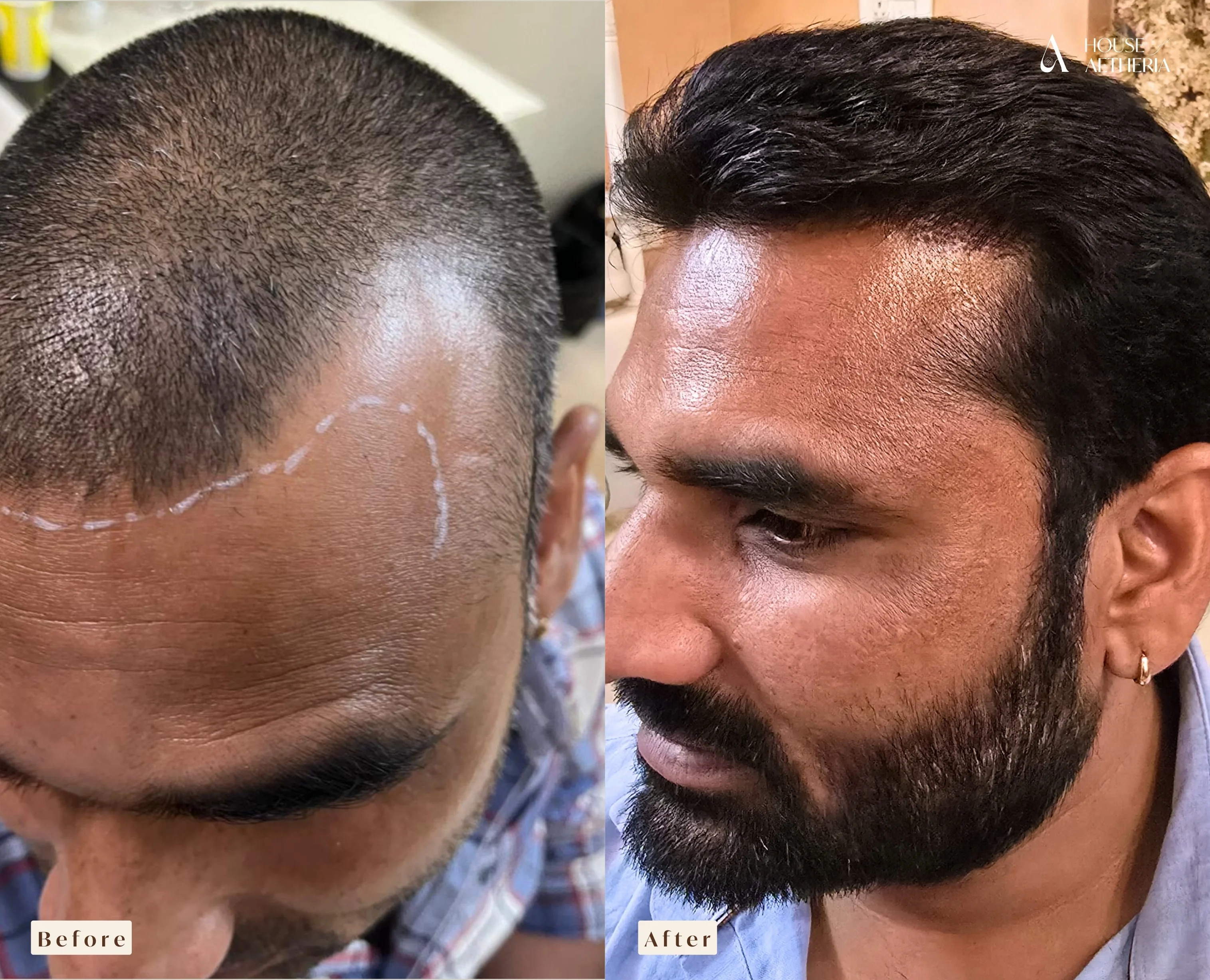
- Weeks 2–4: Scabs lift and transplanted hairs shed. This is shock loss — not failure. The follicle remains anchored. The shaft sheds because the follicle resets into a resting (telogen) phase before beginning a new growth cycle.
- Months 2–3: The scalp looks thin. This is normal. New hair begins emerging — fine, initially without pigment, gradually thickening. Some patients see the first meaningful growth at week ten; others at week fourteen.
- Months 4–6: Meaningful density becomes visible. Around 40–60% of final result is apparent. Hair texture begins to normalise.
- Months 9–12: The majority of patients reach what they and their surgeon consider a satisfying result — natural density, appropriate hairline, hair that behaves like the surrounding native hair.
- Month 14–18: Final result. For some patients with thick Indian hair, the result at twelve months already feels definitive. Others continue to fill in slightly through month eighteen.
Patience is not optional. It is structural to how hair biology works.
Five Questions to Ask Any Hair Transplant Clinic Before Booking
These are not aggressive or unusual questions. A reputable clinic will answer all of them directly. Hesitation or vagueness on any of these is informative.
- Who performs the extraction and implantation? The surgeon should perform both — not delegate either to technicians. Ask directly: "Will you be at the operating table for the full session?" High graft volumes handled by technician teams are a common quality compromise.
- How many patients will you be operating on the same day as me? A rigorous hair transplant session takes six to ten hours. A surgeon managing multiple patients simultaneously is not giving any of them adequate attention.
- What graft storage solution do you use? Grafts held in saline degrade faster than those held in HypoThermosol, ATP-containing solutions, or PlasmaLyte. Clinical research confirms meaningful differences in viability when grafts are kept out of the body for extended periods.[1] Ask the question — the answer tells you something about how seriously the clinic takes the science.
- Can you show me results from patients with a similar hair type and Norwood grade? Results from patients with fine Caucasian hair are not representative of outcomes on Indian hair. Ask for before-and-after photographs from patients whose hair profile matches yours — ideally at twelve months post-procedure.
- What happens if the results are not satisfactory? No responsible surgeon guarantees a perfect outcome — but a responsible surgeon has a clear, documented process for follow-up, assessment, and remediation if results fall below the agreed expectation. Get this in writing.
A Note on Indian Hair Types and Realistic Outcomes
Indian hair carries natural advantages in transplantation — higher calibre (average strand diameter 70–80 microns versus 50–60 microns in fine Caucasian hair), modest natural wave, and a dark colour that creates strong visible density against the scalp. The result: per graft, Indian hair delivers more visual coverage.
This also means density targets that seem modest on paper can look genuinely full in practice. Conversely, patients with very dark, coarse hair against a light scalp may see more visible contrast during the shock loss phase — the period between shedding and regrowth can look stark. Knowing this in advance removes the anxiety that causes some patients to believe the procedure has failed when it has not.
Curly or tightly coiled hair types require specialised extraction technique — the follicle curves beneath the surface, making standard punch extraction more prone to transection (damaging the follicle during removal). An experienced surgeon adjusts punch angle and depth accordingly. This is a skill that comes from volume and training, not from a technique name.

Frequently Asked Questions
What is the difference between FUE and DHI hair transplant?
FUE extracts grafts individually and places them into pre-made recipient sites in a two-step process. DHI uses a Choi implanter pen to place grafts simultaneously with extraction, reducing the time grafts spend outside the body. Both achieve 90–95% graft survival rates when performed by an experienced surgeon. The best technique depends on your hair loss pattern, donor density, and hairline design goals.
How many grafts do I need for a hair transplant in Gurgaon?
Graft requirements depend on your Norwood grade. Norwood 2–3 typically requires 1,000–2,000 grafts. Norwood 4 requires approximately 2,500–3,500 grafts. Norwood 5–6 may need 3,500–6,500 grafts or more. Indian hair, with its naturally higher calibre and wave, achieves strong coverage at lower graft counts compared to fine Caucasian hair. An in-person scalp mapping assessment gives an accurate estimate.
Is hair transplant painful?
The procedure is performed under local anaesthesia. Most patients report mild discomfort during the scalp numbing injections — after that, extraction and implantation are painless. Post-procedure, the scalp feels tender and tight for two to five days, managed comfortably with prescribed pain relief. The experience is far less uncomfortable than most patients expect.
When will I see results after a hair transplant?
Transplanted hair sheds within two to four weeks — this is expected and normal. New growth begins around months three to four. By month six, around 50–65% of the final result is visible. Full density is typically achieved at twelve to fourteen months. Indian hair, being naturally thicker, tends to show impact earlier than finer hair types.
Will the transplanted hair look natural?
Yes — when correctly planned and executed. Naturalness depends on hairline design, the angle and direction of graft placement, and follicular unit grouping (singles at the hairline for a soft edge, doubles and triples behind for density). It also depends on matching the natural hair growth pattern of the patient. Surgeon skill and artistic judgment matter as much as technique choice.
References
- Dua A, Dua K. "Evaluation of a Novel Graft-Holding Solution in Hair Transplantation: A Randomized Controlled Clinical Study." Dermatol Surg. 2023. PubMed: 37036372
- American Society of Plastic Surgeons. "Hair Transplantation and Restoration — Patient Questions." plasticsurgery.org