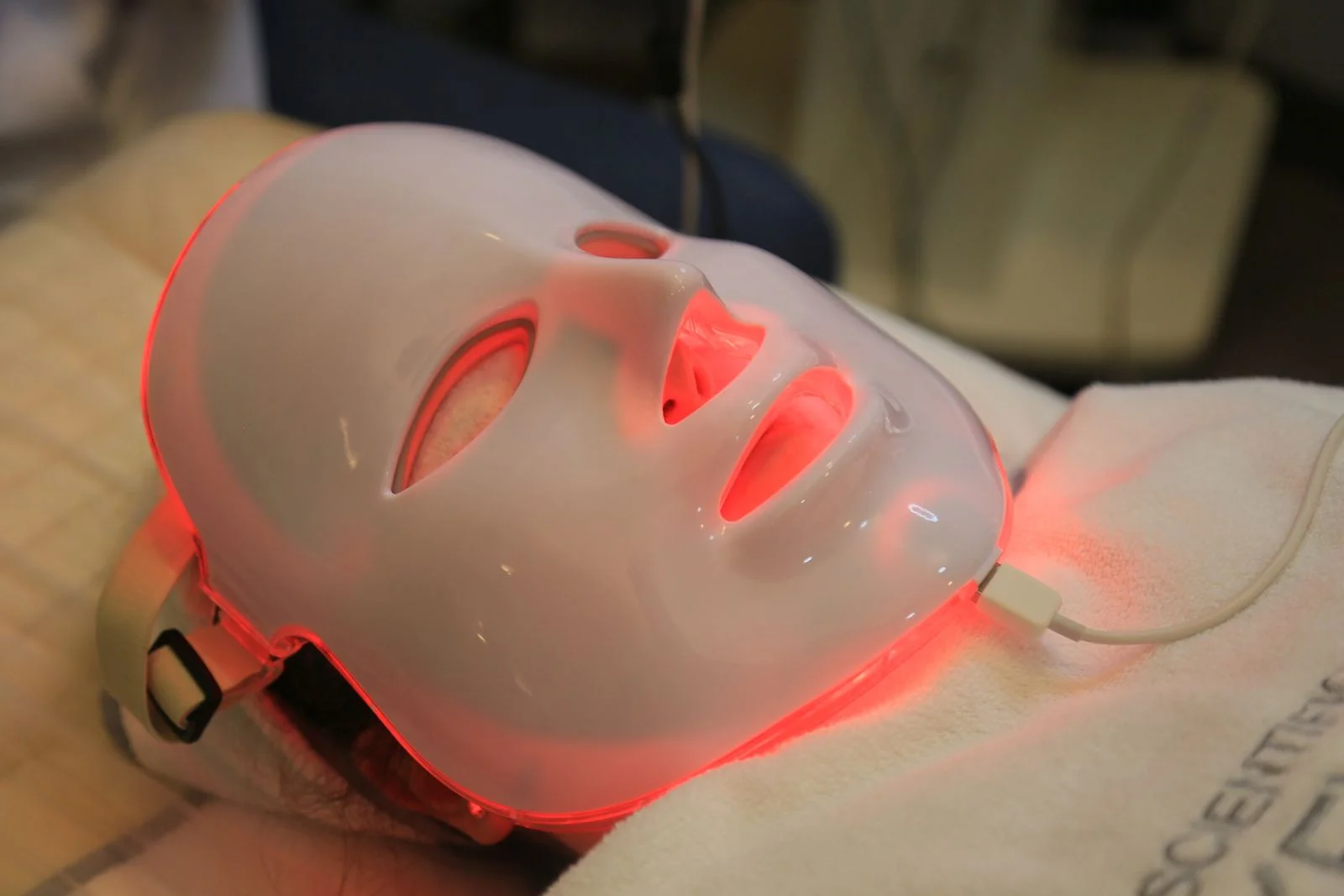
The LED mask on the product listing looks almost identical to the device in the clinic photograph. Same red glow, similar grid of lights, similar product claims. The clinic version costs thirty to fifty times more and requires a booked appointment. The home version ships in two days. The question is obvious: is the clinical device actually different — or is this a clinic margin story dressed as medicine? The honest answer is a device-specification story. And it comes down to four technical facts.
The mechanism — what light therapy actually does to skin
Photobiomodulation is the clinical term. Specific wavelengths of light, delivered at adequate power to the skin, interact with mitochondria in target cells. The result is increased ATP production, reduced inflammatory signalling, and stimulation of fibroblast activity that drives collagen synthesis. Red light at 630 to 700 nanometres targets the dermis. Near-infrared at 800 to 900 nanometres penetrates deeper and promotes tissue repair and circulation. Blue light at around 415 nanometres targets the surface bacteria driving acne. The wavelength determines the target. The power output determines whether the light actually reaches it.
The specification gap — why home devices fall short
The critical measurement is irradiance: power delivered per unit area, expressed in milliwatts per square centimetre. A clinical-grade device like the Celluma panel delivers 100 to 200+ mW/cm² at a consistently calibrated wavelength. Consumer LED masks typically deliver 10 to 30 mW/cm² — and many do not emit their stated wavelength evenly across the device surface. Photobiomodulation requires a minimum photon dose to trigger a cellular response. Below that threshold, you have warm red light on your face. Above it, you have a clinical treatment.
| Factor | Clinical LED Device (Celluma) | Consumer LED Mask |
|---|---|---|
| Irradiance | 100–200+ mW/cm² | 10–30 mW/cm² |
| Wavelength precision | Clinically validated, consistent across panel | Often inconsistent — some emit visible light only |
| Wavelengths offered | Multi-mode (red + near-infrared ± blue) | Usually single-mode, often red only |
| Treatment depth | Dermis and sub-dermal tissue | Epidermis primarily |
| Protocol oversight | Practitioner-supervised, skin-type-specific | Self-timed, no clinical guidance |
| Evidence base | Published RCT data on photobiomodulation | Primarily manufacturer claims |
What clinical LED actually treats — and what it does not
Best-evidenced applications include: acne reduction using blue and red light combined, addressing both bacterial load and inflammation; wound healing and post-procedure recovery acceleration — LED applied after microneedling or peels measurably reduces healing time and post-treatment redness (for a detailed guide on microneedling for acne scars on Indian skin, that article covers how the two treatments combine); and progressive improvement in fine surface texture and mild photodamage. What LED does not do effectively as a standalone: deep scar revision, significant skin tightening, and pigmentation driven by melanin overproduction. For those concerns, LED is a supporting element in a broader protocol, not the lead treatment.
How LED therapy is used at House of Aetheria
The LED light therapy (Celluma) at House of Aetheria is used primarily as an adjunct following microneedling, chemical peels, and laser sessions to accelerate tissue healing and reduce post-procedure inflammation. It is also combined with regenerative treatments such as PRP facial to support the skin's repair response after growth factor delivery. Sessions take around thirty minutes and are comfortable, with no downtime. Whether LED is the right addition to your current skin concern is assessed during a skin consultation rather than booked as a standalone without context.
"LED therapy is one of the most misunderstood tools in aesthetics because it is genuinely useful at clinical grade and genuinely underwhelming from a consumer device. The mechanism is sound — there is solid published literature on photobiomodulation. But the device has to deliver enough photon energy to drive the response. A mask purchased online for two thousand rupees simply cannot do that at the power output it operates. Telling a patient these are the same experience would be factually incorrect. The comparison is not apples to apples — it is apples and a photograph of an apple." — Dr. Guneet Bedi, Dermatologist, House of Aetheria
If you have been using a home LED device without seeing the results you expected, a clinical session and proper skin assessment will tell you both why and what would actually work better for your specific concern. Book a skin consultation at House of Aetheria, Sector 65. Sometimes the device is not the problem. Sometimes it is.