
You have watched the same before-and-after video three times, and you have read the recovery section of every page before booking anything.
It is not that you doubt the surgery. It is that the part you cannot picture is the weeks after it, and what the mirror shows at month three.
At House of Aetheria, plastic surgeon Dr. Rahul Jain plans gynecomastia surgery around the type of tissue you have. This guide walks through the recovery week by week, so you know what is normal and when the result shows.
The short answer
- Gynecomastia surgery is done as day-care surgery. You go home the same day in a compression vest.
- Most people are back at a desk in about 5 to 7 days, and avoid strenuous activity for around 3 weeks.
- Most of the change shows by 4 to 6 weeks, and the final contour is judged at about 3 months.
- Swelling can take longer to settle completely, so the last refinement can continue for several months.
What the result looks like
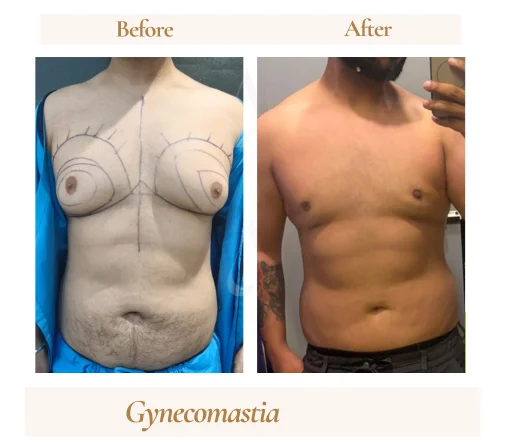
The aim is a flat, natural male chest with a small scar that fades well. When the chest is fatty, liposuction is used. When there is firm gland tissue under the nipple, the gland is removed through a small incision at the edge of the areola. Our guide to gynecomastia versus pseudogynecomastia explains which one you have.
Photos are from our clinic. Results vary with your tissue, your skin and how closely you follow aftercare, and they are not a promise of your result.
Recovery week by week
| When | What to expect |
|---|---|
| Day 0 | Day-care surgery. You go home the same day in a compression vest. Plan for someone to drive you home. |
| Days 1 to 3 | Rest at home. Swelling and bruising are at their worst, and bruising usually peaks around days 3 to 4. Pain is usually managed with the medicines we prescribe. |
| Week 1 | Follow-up visit at one week. Many people return to desk work in about 5 to 7 days. |
| Weeks 2 to 3 | Bruising fades. Light walking is fine. No strenuous activity for around 3 weeks. |
| Weeks 4 to 6 | Most of the change shows. The compression vest is worn for 4 to 6 weeks, and chest and upper-body workouts restart only when your surgeon says so. |
| Month 3 | Follow-up visit at three months. The final contour is judged around now. |
| Months 6 to 12 | Last of the swelling settles. Numbness or altered feeling around the nipple, if you had it, usually improves within a year. |
Avoid sun on the scars for about six weeks, since sun can worsen swelling and the look of a scar.
What changes the result
- Type of tissue. Fat responds to liposuction. Gland tissue needs to be removed, and exercise does not shrink it.
- Skin. Skin needs to shrink back. Stretched skin after large weight loss can need more than liposuction.
- The cause. If a medicine, steroid or hormone problem is still active, the chest can grow back. It is best done once the cause is dealt with.
- Weight. Gaining a lot of weight after surgery can bring fullness back.
- Aftercare. Wearing the vest and holding back on exercise for the full period protects the result.
What people wish they had known before surgery
Men who have been through it, in online forums and in our clinic, tend to say the same few things.
- Check who will operate. Ask who performs the surgery, their training, and how many of these they have done. Do this before you rush into a date.
- Sort out the cause first. Tell your surgeon about every medicine, supplement, steroid and thyroid or hormone problem. It changes the plan and the risk of regrowth.
- Get the vest ready. You will wear a compression vest for 4 to 6 weeks, so ask what you are given and whether a second one is worth having.
- Plan the first days. Arrange a lift home, loose front-opening shirts, and a week with little to do.
- Expect to look swollen first. The chest can look fuller or uneven in the first weeks, and that is normal.
- Do not rush the gym. Going back to chest workouts too soon is the most common reason for a collection of fluid or blood.
What can go wrong, and when to call us
Most people have swelling, bruising, tightness and some numbness, all of which settle. Less common problems include a collection of fluid or blood under the skin, uneven contour, visible scarring and changes in nipple feeling. A collection of blood (a hematoma) is more likely if you return to exercise too early, and it can be treated.
- Swelling that grows quickly on one side.
- A chest that feels very hard or tight, with growing pain.
- Heavy bruising that spreads fast.
- Fever, redness or discharge from a wound.
If you notice any of these, call the clinic the same day. Do not wait for your next visit.
Questions to ask before you book
- Which type of tissue do I have, and will I need liposuction, gland removal or both?
- Who performs the surgery, and where do I follow up?
- What happens if I need a small correction later?
- How should I handle the gym in the first six weeks?
Read the full procedure details on our gynecomastia surgery page, the guide to grades and our cost, recovery and results guide.