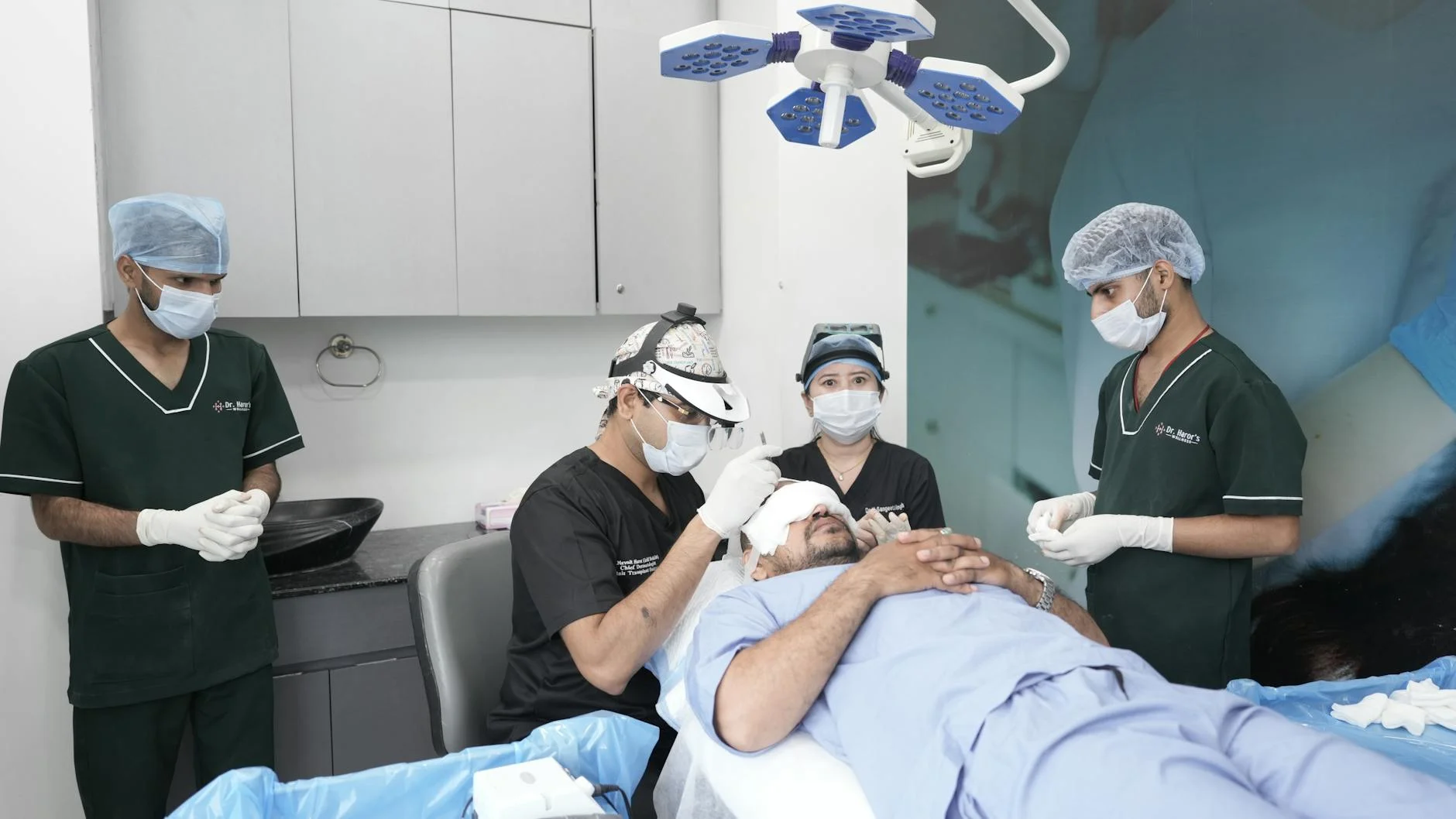
When someone describes a hair transplant as looking fake, they rarely mean the individual hairs look wrong. They mean the overall pattern is off. Something about it reads as artificial even from a distance. The reason is almost never the surgeon's technical skill at extracting or implanting grafts. The reason is design: the angles, directions, and density distribution that make a hairline look like it grew there naturally versus being placed there surgically.
The Three Design Pillars of a Natural Hairline
1. Graft Angle
Natural scalp hair does not grow perpendicular to the skin. At the hairline, hair exits the scalp at an acute angle between 10 and 30 degrees. As you move further back on the scalp, the angle increases to 30 to 45 degrees. If a surgeon implants all grafts at the same angle, or worse, at a steep 90-degree angle, the result is a row of hairs that stand up like fence posts rather than lying flat in a natural flow.
2. Graft Direction
Hair direction varies across the scalp. At the central hairline, hairs point forward. At the temples, they angle downward and slightly backward. At the crown, hairs spiral in a whorl pattern. Replicating these directional patterns during transplant requires the surgeon to continuously adjust the orientation of each implanted graft. Assembly-line clinics where technicians perform implantation often default to a single uniform direction, creating a hedge-like appearance.
3. Density Zoning
A natural hairline is not a sharp line. It is a gradient. The very front edge contains scattered single-hair grafts that create a soft, irregular border. Behind this, a transition zone increases density gradually. The bulk zone sits two to three centimetres behind the hairline with maximum density.
| Hairline Zone | Graft Type | Density (grafts/cm²) | Purpose |
|---|---|---|---|
| Leading edge (0-5mm) | Single-hair grafts only | 15-20 | Creates soft, natural border |
| Transition zone (5-15mm) | Mix of singles and doubles | 25-35 | Gradual density increase |
| Bulk zone (15mm+) | Multi-hair grafts (2-4 hairs) | 40-50 | Maximum density and coverage |
“A natural hairline has irregularity. It has randomness. The micro-variations in angle, direction, and spacing are what make it look real. If every graft is perfectly spaced and perfectly angled, the result looks like artificial turf instead of a lawn.”
— Dr. Rahul Jain, MCh Plastic Surgery, House of Aetheria
Common Design Mistakes
The first and most common mistake is placing the hairline too low. Patients often request their teenage hairline. A responsible surgeon explains that a mature male hairline sits approximately 6 to 8 centimetres above the eyebrow, and designing lower creates an age-inappropriate look that becomes more obvious as facial fat reduces with ageing.
The second mistake is ignoring temporal points. The temples are where hairline design becomes three-dimensional. Flat, straight temporal points look surgical. Natural temples have a gradual, feathered transition that follows the temporal muscle contour.
The third mistake is uniform density across the entire transplanted area. Natural scalp density varies by zone. The frontal region is denser than the crown. Replicating this variation rather than spreading grafts evenly is what separates artistic transplant design from mechanical placement.
Why the Surgeon Must Design the Hairline Personally
At House of Aetheria, Dr. Rahul Jain personally designs every hairline before the transplant begins. This involves assessing facial proportions, bone structure, forehead height, temporal width, and the patient's age-projected facial changes. The design is drawn with a surgical marker, discussed with the patient, and adjusted before a single graft is placed.
This is not a step that can be delegated to a technician or decided by software. Hairline design is as much art as science, and it requires the surgeon's eye, experience, and understanding of long-term aesthetics.
Can an Unnatural Transplant Be Fixed?
In many cases, yes. Revision transplant surgery can soften harsh hairlines by adding single-hair grafts to the leading edge, correcting directional errors, and filling in gaps. However, revision is more complex and expensive than getting the design right the first time.
Before you book a hair transplant anywhere, ask one question: who designs the hairline, and can you see examples of their work across different face shapes? If the answer is vague, your hairline plan probably will be too.
Related Treatment
Hair Transplant (FUE / DHI)
Surgeon-led graft planning with donor preservation and natural hairline design.
View TreatmentExplore further: Unnatural Hair Transplant, Hair Transplant and Cheap Hair Transplant Correction.